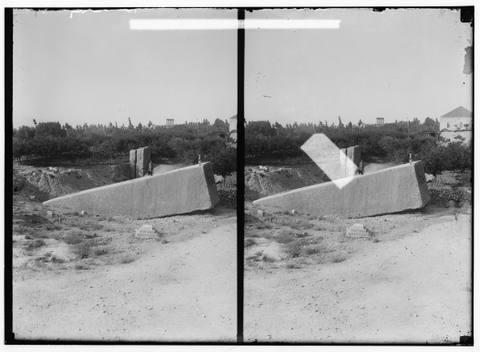
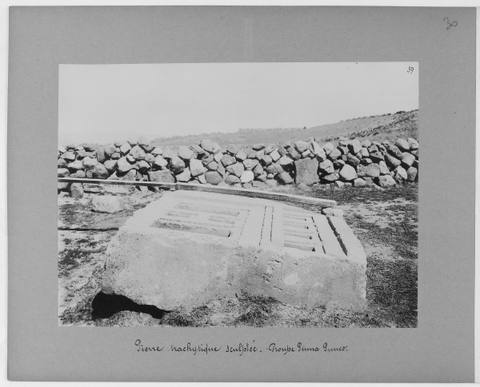
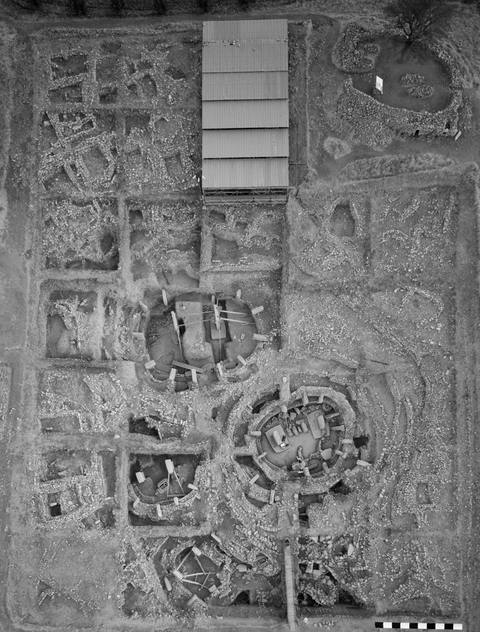
Göbekli Tepe
Türkiye · c. 9500 BCCarved pillars from 9500 BC. The date holds; what the carvings mean is still argued.
Official files, each with a short plain-language summary.
The edition of the two best-preserved logbooks from the Wadi al-Jarf archive (end of Khufu's reign), recording the transport of limestone blocks from Tura to the Great Pyramid. Publisher's catalogue page; the book is in French with an English summary.
Catalogue page of the publishing institute; the papyri themselves are the primary source.
Peer-reviewed report of a large void above the Grand Gallery, with a cross-section similar to the Gallery and a minimum length of 30 metres, confirmed by three muon technologies and three independent analyses.
“Although there is currently no information about the intended purpose of this void, these findings show how modern particle physics can shed new light on the world’s archaeological heritage.” source
Open-access follow-up: a corridor-shaped structure behind the chevrons on the north face, about 9 metres long with a section of about 2.0 by 2.0 metres, measured with Nagoya University emulsion films and CEA gas detectors.
Harvard-based archive of excavation records, photographs, plans and 3D reconstructions of the Giza plateau. The place to check primary excavation material.
Our own reading of the file, written from the sources on the other sheets. Opinion is marked as such.
For most of the modern era, the case for Khufu as builder rested on tradition, inscriptions and the pyramid's place in a sequence of royal tombs. Two finds changed the kind of evidence available. At Wadi al-Jarf, the oldest papyrus archive yet found in Egypt includes the logbook of an inspector, Merer, whose crew ferried limestone from the Tura quarries to Giza. At Giza itself, AERA has spent decades excavating the town that fed and housed the workforce: bakeries, storehouses, galleries and administrators' houses, dismantled after Menkaure's pyramid was finished.
That is why we label the authorship claim confirmed. It is the rare ancient question answered by paperwork written at the time. What the papyri do not do is describe engineering. The ScanPyramids paper itself opens by noting there is no consensus about how the pyramid was built, and the void it found above the Grand Gallery has no known purpose. The 2023 corridor sits behind the north-face chevrons, a feature whose architectural role is itself unclear.
The lost-civilisation reading does not rest on Giza's construction records; it rests on a wider theory of an advanced culture destroyed at the end of the Ice Age. The Society for American Archaeology says a century of fieldwork has produced no evidence for such a culture. The file shows both, and keeps the open questions where they belong: in the stone, not in the authorship.
Graham Hancock argues for a lost civilisation of the Ice Age, possibly destroyed by a comet impact, and says the theory rests on around 100 scientists' peer-reviewed work on the Younger Dryas Impact Hypothesis. For Giza he points to what he calls precipitation-induced erosion on the Great Sphinx and its chronological implications. On that reading, the monuments on the plateau may have a deeper history than the 4th-Dynasty record shows. His argument concerns the Sphinx and the deep past; it does not dispute the Merer logbooks directly.
Source: Response by Graham Hancock to the open letter to Netflix from the Society for American Archaeology
AERA's project page on the 4th-Dynasty settlement south of the Sphinx, excavated since December 1988: over 7 hectares of workshops, bakeries, storehouses, galleries and houses, the base for building the pyramids of Khafre, Menkaure and probably Khufu.
Event page linking the Wadi al-Jarf papyri, described as the oldest papyrus archive found in Egypt, with AERA's work on the Giza waterways and the Lost City.
The professional body for archaeology in the Americas asks Netflix to reclassify the series and add disclaimers, saying a century of fieldwork has produced no evidence for the advanced Ice Age civilisation the series proposes.
“After more than a century of professional archaeological investigations, we find no archaeological evidence to support the existence of an “advanced, global Ice Age civilization” of the kind Hancock suggests.” source
A position statement by a professional society, not a study.
Hancock's rebuttal of the SAA letter. He says his theory of a lost Ice Age civilisation rests on peer-reviewed work on the Younger Dryas Impact Hypothesis, and cites erosion on the Great Sphinx.
Found, but not linked to a source we trust. Not on the sheets until they are.
Level 2. The Archivist's notes are now pinned to the files, redactions open as you read, and your clearance card is ready.