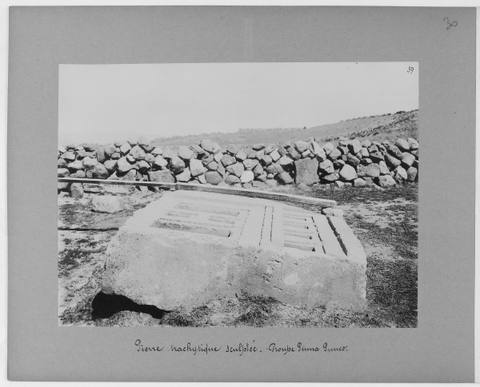
DAI press release on the summer 2014 quarry excavation: a new block of 19.60 × 6 × at least 5.5 m, about 1,650 tonnes, beside Hajjar al-Hibla (about 20 m long, just under 1,000 tonnes), which was abandoned because of poor stone and a natural crack.
“Es handelt sich damit um den bislang größten bekannten Steinblock aus der Antike.” source
German-language release distributed via the Informationsdienst Wissenschaft (idw).
CLASSIFIEDDeclassifiedFILE NO. 018SHEET 2 OF 4
Press
Newspaper and magazine coverage, then and now. Linked, never copied.
Record entry for the Baalbek block: 19.6 × 6 × 5.5 m, about 1,650 tonnes, found in July 2014 by the German Archaeological Institute with Jeanine Abdul Massih of the Lebanese University.
CLASSIFIEDDeclassifiedFILE NO. 018SHEET 3 OF 4
Video
Official footage and video discussions. YouTube loads only when you press play.
COMMENTARYHISTORY (YouTube channel) · DATE TO VERIFY
A clip from the television series Ancient Aliens, on the broadcaster's own channel, presenting the ancient-astronaut idea that the Baalbek platform was a landing pad.
YouTube · HISTORY · loads only when you press play (youtube-nocookie)
CLASSIFIEDDeclassifiedFILE NO. 018SHEET 4 OF 4
Analysis
Our own reading of the file, written from the sources on the other sheets. Opinion is marked as such.
The stones are real and they are enormous. The final phase of the Temple of Jupiter is dated to around AD 60; a stonemason's graffito records 2 August AD 60 on top of one column shaft. Around the temple's own podium runs a second, megalithic wall, and its upper course holds the Trilithon. At least three more giant blocks remain in the quarry a few hundred metres away, including the one found in 2014.
The quarry is the best witness. Several giant blocks still lie where they were cut. The DAI found that Hajjar al-Hibla was abandoned because one corner was poor stone and a natural crack would probably have broken it in transport. That is the ordinary failure of an ordinary quarry, on an extraordinary scale.
What is genuinely open is the sequence. Kropp and Lohmann see Herodian building methods in the inner podium and, as Magli summarises them, read the megalithic wall as a later Julio-Claudian enlargement; Magli argues both were one Herodian plan. None of these readings leaves the Roman period, which is why we label the case explained, with the phase marked as unsettled.
What it shows
That the largest blocks were cut from a quarry close to the temple, where several still lie unfinished.
That the DAI could explain why at least one giant block was abandoned: poor stone and a natural crack.
That the temple's final phase is dated to around AD 60, with a stonemason's dated graffito.
What it doesn't prove
Exactly when the megalithic wall with the Trilithon was built; scholars still argue Herodian versus Julio-Claudian.
How the blocks were moved; no contemporary account survives.
Why the 2014 block stayed in the quarry; the announcement explains only why its neighbour was abandoned.
The other side
Even the scholars admit the puzzle. Magli notes there are no contemporary sources for the building, that its technique is unusually unique, and that the dating of the two podia is unresolved; non-scholarly writers such as Graham Hancock take the megalithic wall as evidence of great antiquity. Ancient-astronaut television goes further and presents the platform as a landing pad for 'sky gods'. Their strongest point is the open sequence: if the wall's date cannot be fixed, the argument goes, it should not be assumed to be Roman.
Peer-reviewed comparison of building techniques at the Jupiter sanctuary in Baalbek and the Temple in Jerusalem. Repository record at RWTH Aachen; full text via DOI 10.1179/007589111X12966443320819.
We opened the repository record only, not the full text; its argument is summarised here from Magli (2016).
COMMENTARYGiulio Magli, Politecnico di Milano · 2016-06-19
Scholarly paper: summarises the dating evidence (final phase AD 60, a graffito of 2 August AD 60, Kropp and Lohmann's Herodian reading) and argues both podia were one Herodian project. Notes that the Trilithon blocks are around 4 × 4 × 20 m.
“Several issues remain unsolved about this site, and in particular the chronology and dating of the two “podia” and the true nature of the cult.” source
Author's preprint; published in Archaeoastronomy in the Roman World (Springer, 2019).
Sceptical review of Ancient Aliens: says the Romans began the complex a few decades BC, that the Trilithon stones weigh about two-thirds of what the show claims, and that they were quarried uphill from the site.
TO VERIFY Candidates, not yet checked
UNESCO World Heritage listing for Baalbek (whc.unesco.org/en/list/294): HTTP 403 to our fetch tool.
DAI e-Forschungsberichte 2014 report on the Baalbek quarries (publications.dainst.org/journals/efb/article/download/1556/4470): connection refused, not opened.
Jeanine Abdul Massih, 'The Megalithic Quarry of Baalbek: Sector III the Megaliths of Ḥajjar al-Ḥibla', Journal of Eastern Mediterranean Archaeology and Heritage Studies 3(4), 2015: full text not opened.
The first German excavation of Baalbek (1898–1903) and the 2004 Lebanese University–DAI quarry project: seen only in search summaries.
Trilithon block weights (secondary sources give roughly 750–800 tonnes each); not verified in a primary source.
Found, but not linked to a source we trust. Not on the sheets until they are.