Scholarly English translation of the Hermetic fragments and testimonies that complete Copenhaver's Hermetica; the publisher's description lists the Emerald Tablet among the texts covered.
OFFICIALIsaac Newton; catalogue record by The Newton Project, University of Oxford · DATE TO VERIFY
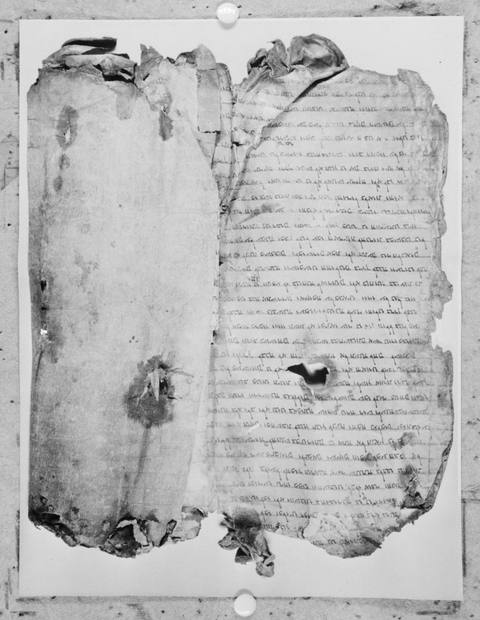
Catalogue record of Keynes MS 28, King's College, Cambridge: Newton's English translation of the Tabula Smaragdina (f. 2r–v), the Latin text (f. 6r) and Latin notes, 'Commentarium' (ff. 6v–7r).
OFFICIALThe Chymistry of Isaac Newton, Indiana University (gen. ed. William R. Newman) · 2010-06
Full transcription of Newton's manuscript on the Emerald Tablet, published by Indiana University, with his English translation, the Latin text and his notes.
“Tis true without lying, certain & most true.” source
CLASSIFIEDDeclassifiedFILE NO. 022SHEET 2 OF 3
Press
Newspaper and magazine coverage, then and now. Linked, never copied.
Feature on the Latin transmission: a manuscript (Arundel MS 164) of the 'vulgate' Latin text, three separate Arabic traditions behind the Latin versions, and Newton's English translation based on the vulgate.
CLASSIFIEDDeclassifiedFILE NO. 022SHEET 3 OF 3
Analysis
Our own reading of the file, written from the sources on the other sheets. Opinion is marked as such.
The Tablet is real as a text and old as a text, but not as old as its legend. Its earliest known version is an appendix to an Arabic encyclopaedia of natural philosophy, the Kitab sirr al-khaliqa, falsely attributed to the Greek sage Apollonius of Tyana, known in Arabic as Balinus. Rudolph places the compilation in the early 9th century; Mandosio calls it a 9th-century treatise. The frame story, in which Balinus finds an emerald tablet in a crypt beneath a statue of Hermes, is part of that book, not independent evidence.
From there the paper trail is clear. Hugo of Santalla put the treatise into Latin in the first half of the 12th century. Another Latin version, the 'vulgate', became the most widely circulated and the basis of later European editions. Isaac Newton copied the Latin, translated it and wrote notes on it; his English opens with 'Tis true without lying, certain & most true.'
What remains open is what lay behind the Arabic. Some scholars have held that the Book of the Secret of Creation translates an older Greek or Syriac work, though no such manuscript is known; others see an Arabic composition drawing on older material. Modern books that borrow the name 'Emerald Tablets' for other texts are a separate matter and outside this label.
What it shows
That the oldest known text of the Tablet is Arabic, in an encyclopaedia probably compiled in the early 9th century.
That it reached Europe through 12th-century Latin translation and circulated widely in a 'vulgate' version.
That Isaac Newton translated and annotated it; the manuscript survives at King's College, Cambridge.
What it doesn't prove
That an emerald tablet was ever found in a crypt; that story comes from the same book as the text.
That the text goes back to ancient Egypt or to a historical Hermes; no earlier manuscript is known.
That Newton endorsed its claims as fact; his manuscript is a translation with notes.
The other side
The case for an older origin is not foolish. Some scholars have argued that the Arabic Book of the Secret of Creation is a translation of a much older Greek or Syriac work, and the Tablet belongs to the broader Hermetic tradition of late antiquity, and a 2018 Cambridge edition of Hermetic testimonies includes it. Absence of an earlier manuscript is not proof that none existed: much of ancient literature survives only in later copies or translations.
Scholarly article on the theology of the Book of the Secret of Creation, a philosophical encyclopaedia that, the abstract says, may have been compiled in the early 9th century during the reign of the caliph al-Ma'mun.
OFFICIALJean-Marc Mandosio, Archivum Latinitatis Medii Aevi 62, 317–321 · 2004
Review of the critical edition of Hugo of Santalla's Latin translation, made in the first half of the 12th century, of a 9th-century Arabic treatise supposedly written by Apollonius of Tyana ('Balinus').
Overview with an extensive scholarly bibliography: oldest version in the Book of the Secret of Creation (late 8th or early 9th century), the Balinus crypt story, Latin translation c. 1145–1151, the vulgate, and the debate over a Greek or Syriac original.
Used as a route to sources and for the scholarly debate; every dating claim here is also backed by Rudolph or Mandosio.
TO VERIFY Candidates, not yet checked
Maurice Doreal's 'The Emerald Tablets of Thoth the Atlantean' (c. 1930, Brotherhood of the White Temple, Denver): a different, modern text that must be kept apart from the Hermetic Tablet. Only Wikipedia's 'Maurice Doreal' article was opened (it gives his real name as Claude D. Dodgin and his claim to have found tablets at Giza in 1925); a second, non-Wikipedia source is needed before this goes on the sheets.
Heinrich Khunrath, Amphitheatrum Sapientiae Aeternae (Hanau, 1609 edition; Emerald Tablet plate dated 1606): no library page opened.
E. J. Holmyard, 'The Emerald Table', Nature 112 (1923), doi 10.1038/112525a0: not opened.
Ursula Weisser's edition of the Book of the Secret of Creation (De Gruyter, 1980), doi 10.1515/9783110866933: publisher page returned HTTP 405.
Britannica, 'Emerald Tablet': HTTP 403.
Found, but not linked to a source we trust. Not on the sheets until they are.